
Prilosec Is Evil (IMHO)

About five years ago, I realized that the amount of dessert I was eating every night basically added up to a fourth meal. Rather than give up dessert (let’s be honest, that wasn’t going to happen), I decided to try intermittent fasting.
I stopped eating breakfast and thought I’d hacked the system. The first month was rough — by 10:30 a.m. I was ravenous — but eventually my body adapted, and it became easy to wait until 1 or 2 p.m. to eat.
What I didn’t give up, though, was my morning coffee.
Everything went smoothly for about two years — until slowly but surely heartburn reared its ugly head.
I had eaten my fair share of TUMS over the years but they couldn’t touch what I was going through.
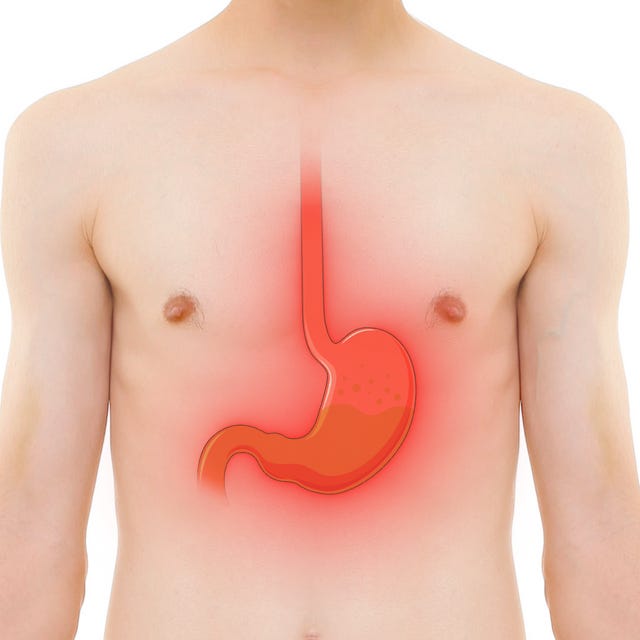
Acid reflux, also known as GERD (gastroesophageal reflux disease), happens when stomach acid backs up into the esophagus — the tube that carries food from your mouth to your stomach. Unlike the stomach, the esophagus doesn’t have a protective lining, so when acid rises, it burns. Literally.
That burning in your chest and throat after eating — that’s acid reflux.
In my case, it got so bad that I sometimes couldn’t finish dinner because the pain in my chest was so intense. Sometimes I would wake up in the middle of night thinking I was about to throw up but it was only bile coming up. Ewww!
I don’t go to the doctor much, but last spring I decided it was finally time to deal with hepatitis C, a chronic condition I’ve had since the early eighties. (It wasn’t even called hepatitis C then — just “Non-A, Non-B.”)
When the doctor asked, eyes glued to his screen as they had been for the entire visit, if there was anything else bothering me, I mentioned heartburn. Without hesitation, he said, “Okay, here’s a prescription for Prilosec. Take it for a few months and we’ll revisit.”
I needed relief, so I filled the prescription. Even though I generally avoid medication (except the occasional recreational kind), I figured this one might help.
Later that day, I was on a group call with some clients and mentioned that I’d started Prilosec. Two people immediately warned me: “Don’t do it. If you stop taking it, the heartburn will come back worse.”
I should’ve listened.
Still, I took it for three days — and those three days were pure bliss. No burning, no indigestion, just peace.
But while my stomach was happy, my brain was busy reading. Everything I found online — studies, articles, forums — painted the same picture: Prilosec can be a trap. Once you’re on it, your stomach ramps up acid production the moment you stop, making symptoms worse than before.
That’s not to say Prilosec isn’t necessary for some — many people deal with far more complex intestinal issues than I do — but I stopped taking it after just three days.
Sure enough, the heartburn came roaring back, even worse.
At that point, I did what I always ask my clients to do: play detective.
What had changed in the years leading up to this? The only thing I could think of was starting intermittent fasting.
So, as an experiment, I stopped drinking coffee.
Within days, the heartburn began to ease. Within six weeks, it was completely gone.
Six months later, I started eating breakfast again and brought back my morning coffee — no issues at all.
So while Prilosec may work for some, I’m grateful I didn’t stay on it. It didn’t solve my problem — it just masked it.
In my case, the issue wasn’t too much acid — it was an empty stomach and a steady stream of caffeine. Once I addressed that, my digestion settled down naturally.
Your body is always trying to tell you something. The trick is learning to listen.